Marine and coastal modelling is applied to analyse hydrodynamic processes governing coastal and offshore environments. Numerical simulations are used to investigate the interaction of waves, currents and tides with natural coastlines and engineered systems, supporting coastal planning, port development and marine infrastructure studies.
Coastal and Marine Hydrodynamics
We deliver state-of-the-art numerical modeling of coastal hydrodynamics and wave transformation, from offshore conditions to the nearshore and shoreline interface. By coupling spectral wave propagation models with free-surface 2D/3D hydrodynamic solvers, we reproduce the key processes governing coastal response—shoaling, refraction, diffraction, breaking, wave–current interactions, tides, and wind forcing. This integrated approach supports coastal flooding and marine submersion assessments, the dimensioning of maritime structures, and coastal protection and resilience studies, providing scientifically robust metrics for design conditions, hazard levels, and mitigation performance under present and futurs scenarios.
Waves, Currents and Tidal Processes
Numerical studies increasingly focus on 2D and 3D hydrodynamics to capture the combined influence of tides, background/general circulation, and wind forcing on coastal and marine systems, from open coasts to semi-enclosed basins. These modelling frameworks resolve water levels, depth-averaged and/or vertical current structures, and their spatio-temporal variability under both operational and extreme conditions. When relevant, the hydrodynamic core is coupled to a wave-propagation model to account for wave–current interactions, including wave-induced currents (via radiation-stress gradients) and Stokes drift, improving the representation of nearshore transport and hydrodynamic forcing. This integrated approach supports the assessment of coastal response, sediment pathways, and loading conditions required for engineering design, shoreline management, and the performance of marine structures.
Port Agitation and Harbour Hydrodynamics
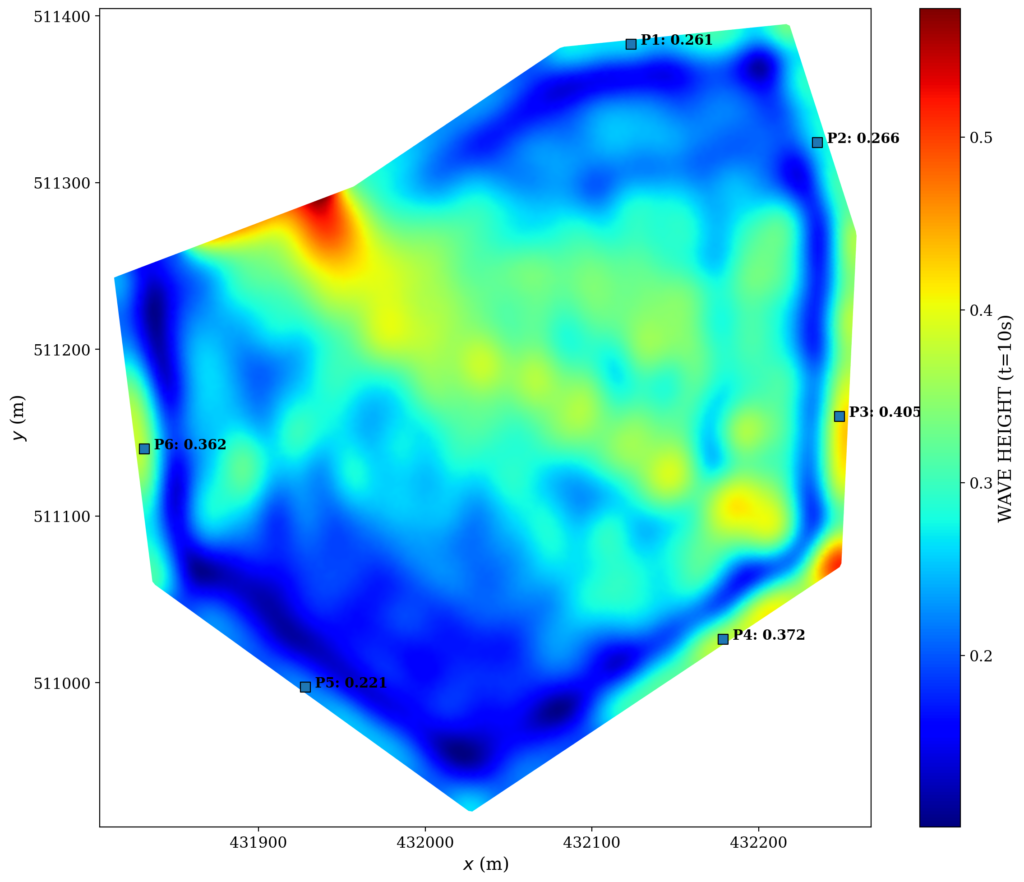
Port and harbour modelling focuses on wave penetration, basin resonance and circulation processes within enclosed and semi-enclosed basins. Numerical simulations are used to assess agitation levels, mooring conditions and vessel operability under a range of sea states and tidal conditions.
Results support navigation safety, harbour performance and the optimisation of port layouts, contributing to informed decision-making for port design, expansion and coastal protection measures.
Results support navigation safety, harbour performance and the optimisation of port layouts, contributing to informed decision-making for port design, expansion and coastal protection measures.